



Sharp cooling, strong winds, and temperature fluctuations are the standard picture for winter in Kazakhstan. To ensure your HVAC equipment survives the season without breakdowns and heating bills don’t eat up your budget, it is crucial to conduct a timely revision.
Preparing engineering systems is not just a formality, but a guarantee that in the spring you won’t have to replace expensive compressors or stop office operations due to an emergency. Experts from “Climate PROF Kazakhstan” have compiled a detailed action plan.
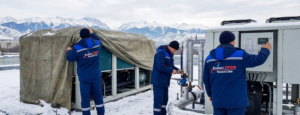
1. Chillers and Air Conditioning Systems: Conservation or Adaptation?
The main mistake business owners make is simply turning off the cooling system and forgetting about it until May. In our frost conditions, this can lead to heat exchanger freezing and equipment failure.
If cooling is not required in winter: Conservation Mode
For “chiller-fan coil” systems running on water, it is critically important to drain the heat carrier from the outdoor circuit to avoid pipe rupture during freezing.
-
System Purging: Remove residual moisture from hydraulic modules.
-
Heat Carrier Replacement: If draining is not possible, replace the water with a non-freezing liquid (ethylene glycol or propylene glycol) of the required concentration.
-
Mechanical Protection: Cover fan units with protective covers to shield them from snow, ice, and debris.
If cooling is needed year-round (Server rooms, technical rooms): Installing Winter Kits
Domestic air conditioners are not designed to operate at -10°C and below. The oil in the compressor thickens, and the drainage freezes. To ensure a split system works in a server room during winter:
-
Install a Winter Kit (Low Ambient Kit). It includes a compressor crankcase heater and a fan speed controller.
-
Equip the drainage system with a heating cable so that condensate does not turn into an ice plug.
Important: Climate equipment in Kazakhstan operates in a sharply continental climate. Standard “European” preparation may not work here — a safety margin for temperatures is required.
2. Fighting Heat Loss: Checking Tightness
The most expensive resource in winter is heat. Often, businesses heat the street due to minor defects in the ventilation system and building envelope.
-
Seal Revision. Check the air dampers (valves) in the ventilation system. If the sealing rubber has dried out, icy air will seep into the room even when the supply unit is turned off.
-
Line Insulation. Check the insulation of Freon lines and heating/supply pipes. Even a small exposed section of a pipe outside or in a cold attic leads to colossal energy losses.
-
Joint Sealing. Inspect the places where air ducts pass through walls and roofs. All gaps must be securely sealed to eliminate drafts.
3. Air Humidity: The Invisible Enemy of Comfort
In winter, the air in Almaty premises becomes critically dry due to the operation of heating appliances. Humidity drops to 15–20% (with a norm of 40–60%).
Why this is dangerous for business:
-
Employee Health: Mucous membranes dry out, immunity decreases, and viruses spread faster.
-
Equipment: Static electricity increases, which is dangerous for servers and electronics.
-
Interior: Furniture and parquet dry out, doors deform.
Solution: Check and prepare humidification systems (steam or adiabatic). If you don’t have them, it’s the right time to consider installing industrial humidifiers in the ventilation duct or local units for the office.
Summary
Preparing equipment for winter is an investment that pays off by the absence of emergency repairs.
What needs to be done right now:
-
Conduct chiller conservation (drain water or fill with glycol).
-
Retrofit air conditioners in server rooms with “winter packages”.
-
Restore insulation of pipes and air ducts.
-
Check the seals of ventilation valves.
-
Launch and configure air humidifiers.
Don’t want to risk expensive equipment? Entust the preparation to professionals. Engineers at “Climate PROF Kazakhstan” will conduct a full audit and service maintenance of your systems before the cold weather sets in.